Speaking on the Polish B1 exam — photo, monologue, tips
3 min read
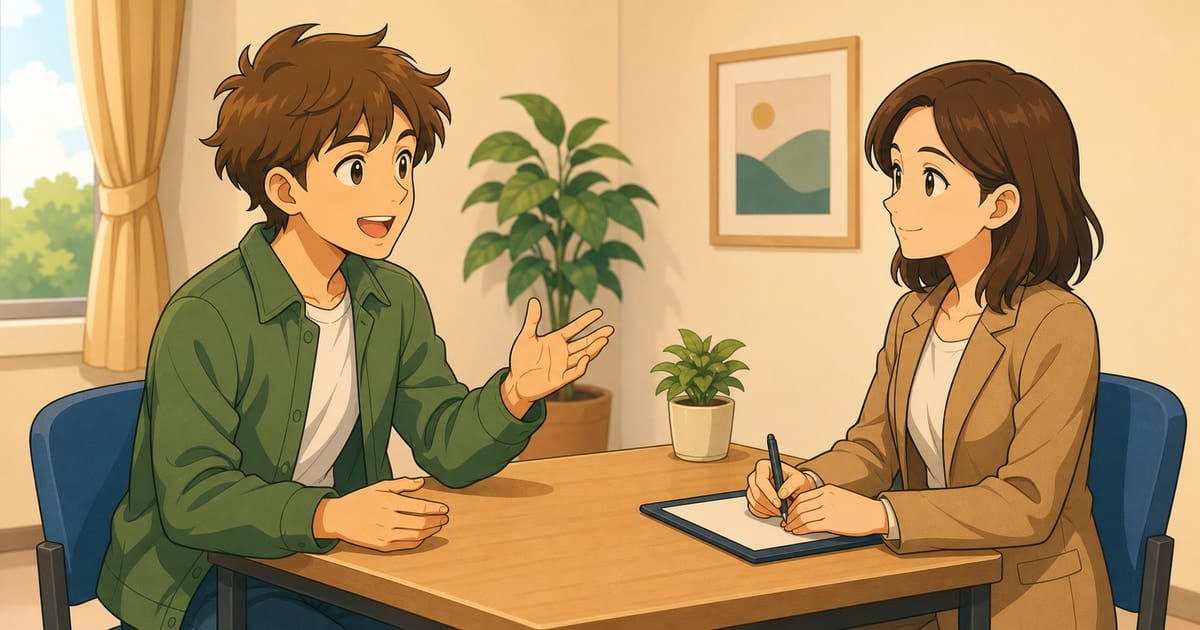
The speaking part of the B1 exam is the oral exam — it lasts about 15 minutes and is worth 40 points. To pass it you need at least 50%, i.e. 20 points. You talk to an examiner, usually completing three tasks: describing a picture, a longer statement on a topic (a monologue), and a short conversation or role-play.
Below we explain each task and give you the phrases worth keeping "in your pocket".
What the oral part consists of
- Photo / picture description — you say who and what you can see, what the people are doing, where they are and what the mood is.
- Monologue on a topic — a longer, coherent statement, e.g. "Talk about your favourite way of spending free time".
- Conversation / situation — you respond to the examiner's questions or act out a scene (e.g. booking a table, a doctor's appointment).
How it is scored
The examiner assesses:
- Task completion — whether you answered what you were asked.
- Fluency and communicativeness — whether you speak reasonably freely and can be understood.
- Grammatical accuracy and vocabulary — range and precision.
- Pronunciation — it doesn't have to be perfect, just intelligible.
Most important of all: keep talking. A short "I don't know" costs more than a sentence with a minor mistake.
How to describe a photo — a simple scheme
Stick to a simple order:
- Who? — Na zdjęciu widzę młodą kobietę i dwoje dzieci. ("In the photo I can see a young woman and two children.")
- What are they doing? — Oni jedzą śniadanie / rozmawiają / spacerują. ("They are having breakfast / talking / going for a walk.")
- Where? — To dzieje się w kuchni / w parku / na ulicy. ("It's happening in the kitchen / in the park / in the street.")
- What's the mood? — Wygląda na to, że są zadowoleni / jest spokojnie. ("They seem happy / it feels calm.")
- Your opinion — Myślę, że… / Moim zdaniem… ("I think that… / In my opinion…")
Useful phrases: Na pierwszym planie… (in the foreground) · W tle… (in the background) · Po lewej / prawej stronie… (on the left / right) · Wydaje mi się, że… (it seems to me that…)
Useful phrases for the monologue and conversation
- Starting: Chciałbym opowiedzieć o… (I'd like to talk about…) · Zacznę od… (I'll start with…)
- Structuring: Po pierwsze… po drugie… (firstly… secondly…) · Na koniec… (finally…)
- Opinion: Uważam, że… (I believe that…) · Z jednej strony… z drugiej strony… (on the one hand… on the other…)
- When a word escapes you: Jak to powiedzieć… (how should I put it…) · Mam na myśli coś takiego, że… (what I mean is…)
- Asking for repetition: Przepraszam, czy może Pani powtórzyć? (Excuse me, could you repeat that?)
The most common mistakes
- Answers that are too short — develop the thought, add an example or a reason.
- Going silent when a word is missing — use a periphrasis (describe it in other words).
- Learning set speeches by heart — the examiner will sense it; it's better to speak naturally.
- Speaking too fast — talk calmly; it improves both pronunciation and intelligibility.
How to practise speaking
Speaking is best learned by speaking out loud. In our practice module you'll find photo description and monologue tasks in the exam format — you record your answer, and the AI evaluation checks it against B1 criteria and tells you what to improve.
It's also worth revising grammar (verb conjugation, cases), because mistakes are just as audible in speech as they are visible in writing, and having a look at what the Polish B1 exam looks like to see the whole picture.
In short: ~15 minutes, 40 points, 50% threshold. Describe photos with the scheme (who–what–where–mood), develop your answers, never go silent — and practise out loud with feedback.